





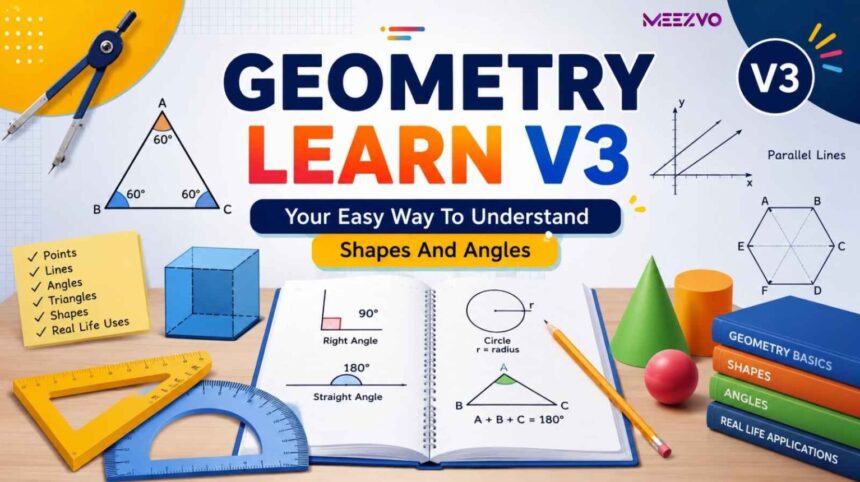
Introduction to Geometry Learning V3
Geometry is more than just a subject you might remember from school; it’s a fascinating world filled with shapes, angles, and patterns. Whether you’re an eager student or just someone looking to brush up on your skills, Geometry Learning V3 offers the perfect solution for understanding these concepts with ease. Imagine diving into the realms of points, lines, and planes like never before. This guide will take you through everything you need to know about geometry in a fun and engaging way. Get ready to unlock the mysteries behind circles, triangles, squares—and so much more! Let’s embark on this geometric journey together and discover how these elements shape our world.
- Introduction to Geometry Learning V3
- Understanding the Basics: Points, Lines, and Planes
- Exploring Shapes: Circles, Triangles, Squares, and more
- Mastering Angles: Acute, Obtuse, Right, and Straight
- Practical Applications of Geometry in Daily Life
- Tips for Retaining Information and Improving Geometry Skills
- Conclusion
Understanding the Basics: Points, Lines, and Planes
Geometry starts with three fundamental concepts: points, lines, and planes.
A point is a precise location in space. It has no size or dimension but serves as the building block for more complex shapes. Imagine it as a dot on paper; it marks a specific position without any further properties.
Next comes the line. A line extends infinitely in both directions. It’s straight and has no thickness, connecting two points while continuing endlessly beyond them.
Then we have planes—flat surfaces that stretch out indefinitely in all directions. Think of a plane like an endless sheet of paper where you can draw countless shapes and angles.
Understanding these basics sets the stage for diving deeper into geometry’s fascinating world. Each concept interconnects to form various geometric figures, enriching our comprehension of spatial relationships around us.
Exploring Shapes: Circles, Triangles, Squares, and more
Shapes are the building blocks of geometry, each with its unique properties and characteristics.
Take circles, for instance. They have no corners or edges, yet they are perfectly symmetrical. This round shape plays a crucial role in design and engineering.
Triangles come next—they’re all about stability. With three sides and angles that add up to 180 degrees, triangles form the foundation of many structures around us.
Then we have squares and rectangles. These four-sided shapes boast equal sides or opposite sides that match in length. Their versatility makes them useful in everything from architecture to art.
Don’t overlook polygons either! Shapes like pentagons and hexagons introduce even more complexity while still adhering to simple rules regarding their sides and angles.
Exploring these forms can ignite creativity and deepen understanding of how they interact in our world—both abstractly and practically.
Mastering Angles: Acute, Obtuse, Right, and Straight
Angles are essential in geometry, and mastering them is crucial for understanding shapes. Each type of angle has its own unique characteristics.
Acute angles measure less than 90 degrees. They bring a sense of sharpness to geometric figures, often seen in triangles.
On the other hand, obtuse angles exceed 90 degrees but are less than 180 degrees. These wider angles can create dynamic visual effects in various designs.
Right angles stand out at exactly 90 degrees. You find them everywhere—in squares, rectangles, and even everyday objects like books and door frames.
Straight angles measure precisely 180 degrees. They form a perfect line and represent balance within geometric configurations.
Recognizing these different types will enhance your spatial awareness and deepen your appreciation for geometry’s fascinating world.
Practical Applications of Geometry in Daily Life
Geometry is all around us, often in ways we don’t even notice. From architecture to art, the principles of shapes and angles play a vital role.
Consider construction. Builders rely on geometric concepts to create stable structures. They use triangles for strength and rectangles for balance, ensuring safety and durability.
In everyday situations like shopping, geometry helps us navigate space efficiently. Store layouts are designed with shapes that draw customers in and guide them through aisles seamlessly.
Even technology benefits from geometry. When designing graphics or user interfaces, developers apply geometric patterns to enhance usability and aesthetics.
Cooking involves geometry too! Measuring ingredients requires an understanding of volume and surface area—critical components of culinary success.
This intricate blend of theory and practicality shows how essential geometry truly is in our lives.
Tips for Retaining Information and Improving Geometry Skills
To enhance your geometry skills, try to visualize concepts. Use diagrams or draw shapes. Seeing them in action can solidify understanding.
Another effective method is to practice regularly. Dedicate a specific time each week for geometry exercises. This will help reinforce your learning and improve retention.
Teaching someone else can also be beneficial. Explaining geometric principles helps clarify your own understanding while reinforcing the material.
Consider using apps or online resources that gamify learning. Engaging with interactive content makes studying more enjoyable and often more memorable.
Connect geometry to real-life scenarios. Whether it’s measuring furniture for a room layout or calculating angles in sports, applying what you learn creates stronger connections in your brain.
Conclusion
Geometry Learning V3 offers an accessible pathway for anyone looking to grasp the intricate world of shapes and angles. By starting with the fundamentals like points, lines, and planes, learners build a solid foundation that supports more complex concepts down the line.
Exploring various shapes such as circles, triangles, and squares not only enhances spatial awareness but also sparks creativity in problem-solving. Mastering different types of angles expands understanding further and sets the stage for real-world applications.
The practical uses of geometry are all around us—from architecture to art—showing just how vital these principles are in daily life. With effective strategies for retaining information and improving skills, students can feel confident as they navigate through their geometry learning journey.
Embracing Geometry Learning V3 means stepping into an engaging way to understand mathematics better while applying it meaningfully in everyday situations. This approach ensures that both students and enthusiasts alike can appreciate the beauty of geometry without feeling overwhelmed by complexity.